I had not heard this term, and my first thought was skinny-dipping – not? Oh, I am just a country bumpkin, a late adopter. It is cutting edge, the initiative to engage urban dwellers (voters) in a deep sensory awareness of the forest. Not an intimidating athletic rush through miles of forest, nor an academic challenge in taxonomy. It is guiding the stressed to listen, to look, to smell, to immerse themselves in the greenery that is an oasis in the concrete jungle (thanks to the arborists and the landscape architects). It began in Japan, as shinrin-yoku. That made sense to me, then – the land of bonsai, of elegant gardens, of perfect symmetrical Mt. Fuji. Transliterated into English, it sounded a bit contrived, but of course! I, too, know to ask children on field trips to take moments to pause, close their eyes, and just listen to birds, bees and running water. I have even asked an Ambassador to do so, deep in a Micronesian forest. A minute is a long time but transformative.
So, suddenly, it was my buzzword. I heard of it at a conference. It sounded a bit yuppie. The following week, I met a classmate who leads groups in “forest therapy” in Manhattan. My brother said he heard of it months ago. (He always has been ahead of me on the curve.) I would have just called it “being in the woods,” not saying anything more about it, in proper laconic style.
I was eager to revisit my woods, this vacation. I hiked intent on my destination, and then I did remember to look up, and see the full canopy, floating above as the opposite slope and stream fell away to one side. I conversed with my fellow-hikers, and then I was stopped and silenced by a furious red squirrel. Yes, I was forest bathing, but could I say it with a straight face? Little boys do love toads. Would a city dweller want to notice moose poop? Would it be sensory, or scary? One fellow wisely hung far back, as we went on, hoping for a glimpse of the moose. We detoured to the little-known south peak, with its plaque to Pennington Haile, the man whose donation enabled the purchase of the peaks and ravine. I did dip into the pools of the Asquamchumauke – the first was hyperventilation, the second was acclimation, and the third was a spreading warmth as my body began to generate energy and heat in response to the shock of the frigid water.
Further north, I spotted a beaver’s dam and pond and the outfall over green moss – an ambitious animal at quite a high elevation. Yet higher, a pond backed by the full glory of the headwall, and two women painting en plein air. A pond that had been clean enough to drink from when we were children, and we wanted to believe that it was still so. We plunged our empty water bottles into it, brims below the scattered bits of pollen on the surface. Four hikers went into a tizzy, their advisories shattered. “Can you drink that? Can you drink that?” They didn’t need water, but they really needed an answer. “Yup,” said my brother. “The Park won’t tell you so, but we can.” Oh, that upset the painters. One quickly said, “After you treat it! You have to treat it!” The other woman went into an apparent non sequitur about how you wouldn’t believe how many people she had seen, peeing, right in her distant but full view, as they climbed the headwall. Pooping, too. She seemed to disapprove of the drinking of any water that led to the peeing. There was no real choice, being en plein air, once one was on the headwall. I had to ask, “Do you paint them, then?”
We bluffed our way past the ranger. She too needed an answer, so we lightly said we’d take the Cathedral trail, since we’d already done all the other trails (we didn’t say how long ago that had been). “Tell me more about your thought processes for that choice,” she asked, far too maternally for someone so young. We figured we would at least get a view before we might decide to turn back. “As you go along that trail, keep on thinking about whether you are approaching a point of no return,” she said. “Some of those places, when you are about to climb up them – think about whether you want to climb back down them.” Good point.
We went on, and quickly up. The four hikers emerged from the woods below us. They, too, had gotten past the ranger, but appeared bewildered by the jumble of rocks. “How is it?” they called up to us. “Great!” said my brother. “You can do it!” A half hour later, we stopped to drink. “They turned back,” he said to me. At that moment, two of the boys appeared below us. “We’re from Florida,” they said. “We never saw anything like this before. Dad went back to the lake to wait.” They soon disappeared above us. “Whippersnappers,” we said.
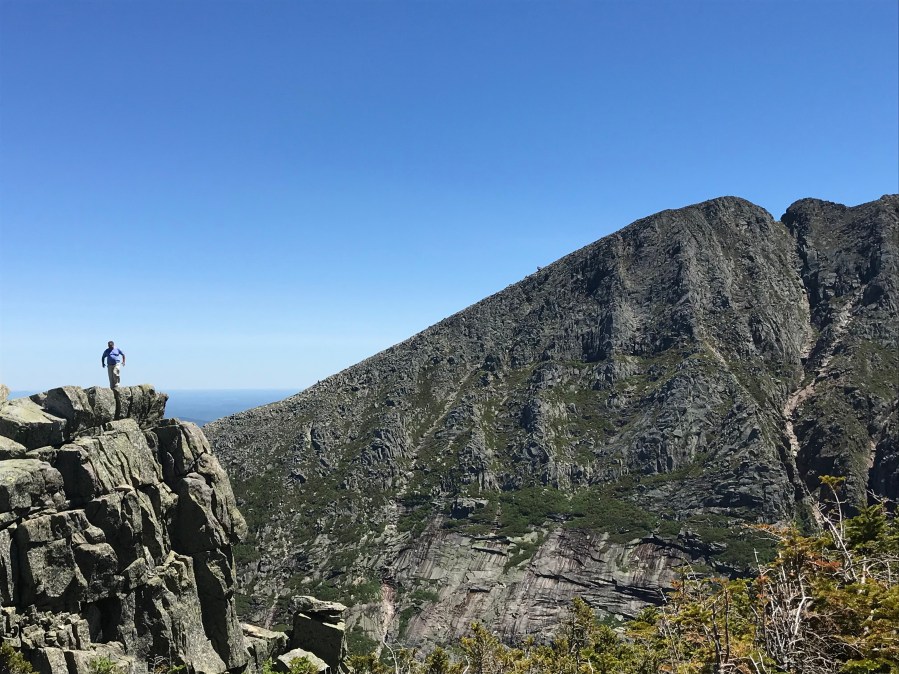
Rock bathing, blue paint trail markers and lichens and little ecosystems at eye level on each next rock. Bathing in the sudden breezes of cold air from ice hidden under the rocks, melting onto pads of moss supporting bonsai birches in the crevices. Landscape bathing in the cirque that surrounded us and the lakes and mountains that came into view with every rise. The Penobscots knew Katahdin as the private realm of a jealous god, Pamola, who would punish anyone who might venture onto his exposed slopes, with sudden storms and certain death. I thought about Yahweh’s anger at mortals who thought they could build and climb the Tower of Babel, thus approaching God on their own terms instead of His. This day was so miraculously clear and still and free of fear, that we felt the Creator was calling us up the mountain; a Greater Spirit was saying “You can do it.” That realization became our point of no return – an invitation not to refuse.
The first, second and third Cathedrals are successive pitches over columns of granite, leading through the krummholz to Baxter Peak. A century ago, the man who would become Governor began building the vision of state acquisition of the mountain and its surrounding forests. The path to that acquisition was a circuitous one. It was not until after his term as Governor that he began to buy parcels with his own funds, lands still encumbered by timber agreements that would not expire for decades. A good lesson in persistence and the long view. A plaque at the summit formally proclaims that the state accepted Baxter’s gifts and committed to maintain the land, forever wild.
After the sacred silence of the trail from the cirque, the summit was busy with chattering visitors who had come up the Appalachian Trail from the south. A raven surfed the light breeze overhead, back and forth. Some people busied themselves with their selfies; some people watched the unexpected bird. The raven settled heavily next to a cairn, paused, lunged at some slow prey, and departed.
The solstice day gave us long hours to descend by the saddle, past the pond, past the ranger, past the mistress of the painting school, step by step down the trail, now destination-focused. The next day, we did slide the falls on Nesowadnehunk Stream and we did holler and hyperventilate. We bypassed the Interstate and drove back roads down the Piscataquis, to see the new fish ladder at the Howland dam – one could paddle it in the spring floods. Past the dams that have been removed to free the Penobscot, past the Kenduskeag, down the Kennebec (where we saw sturgeon jumping), over the Androscoggin and the Piscataqua. To the airport.
Postscript: the airline’s free Wall Street Journal carried an article, “In Search of Nature’s Pool Party: Nothing replenishes an overheated explorer quite like a wild swimming hole – if only you know where to look…” It discusses gear required (nanodry towel $20, sandals $105, hydro daypack $120, maps app $4, hiking poles $170). Then, the author states “And while you might be tempted to leave modern conveniences behind while answering the call of the wild…” [what gadget is there now for doing that on a headwall?] “…you’ll want a smartphone charged and ready.” OK, that is quicker than waiting for someone to paint you!
(June 2018)


 The Singing Forester