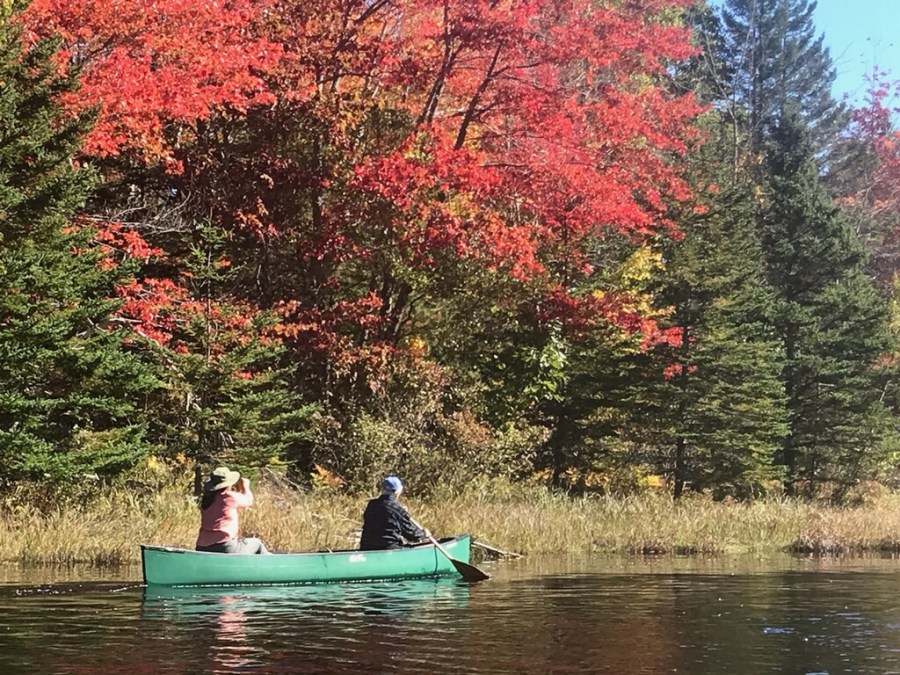
There was a lot that my parents didn’t tell their innocent children about picture-perfect New England. I imprinted like a duckling on the white churches of Puritans nestled in the rolling hills of farms and fall colors. There was a decade or two when I was a child, when my grandmother was at rest in her tidy farm kitchen, when the wildflowers grew over the barnyard and into the hayfields, and a sweet fallow reclaimed the land. With the intensity of a ten-year-old, I embraced three centuries of ancestral nostalgia for a precise aesthetic of clapboard, stone walls, and Yankee thrift and reserve. Play and joy found their channels in the out-of-doors. “The heavens are telling the glory of God, and the firmament proclaims His handiwork…” Indeed, the apple trees blossomed in the spring like brides of Christ, and the canopy of autumn leaves filtered light like panes of stained glass giving out their own luminescence on a soft cloudy day.
We drank my mother’s homemade root beer without understanding how it achieved that sweet fizz, and only my father knew that he had his own beer in the cellar. Years later I learned that apples fallen from the trees in October could produce cider that was hard as soon as it was squeezed into the jug. I began to see the forested hills in a different light. The white birches remembered the church and stood like bright steeples in the woods, but the rest of the forest drifted away up the slopes toward other festivities. Oaks donned their russet woolens and mingled with partygoers wearing gold sequins and voluptuous orange silk. Pine green men stood tall above streamside maples in strapless cherry-red dresses. Yellow-green popples looked like tropical citrus mixed drinks. Some trees branched widely like bursts of fireworks; with the ingenuity of Chinese pyrotechnics, streams of green ended in bursts of orange, and stars of yellow popped in red at the tips. Statuesque sun-grown sugar maples billowed out in shining brassy leaves that were ripe to be blown away in the first good wind, a wardrobe malfunction that would leave their limbs bare to the world.
Rental cars and SUVs with Virginia license plates veered drunkenly down the road from one maple to the next. Entire families on bicycles pedaled wide-eyed under the flaming trees, wandering off the carriage roads and onto the streets, where their yellow jerseys and orange vests were no longer protection but camouflage. “Friggen leaf-peepers,” said the neighbors. Not wanting to see the collisions, and tired of the never-ending imperative for the picturesque, they left the bright sunny day and went into the dark tavern to watch the belt sander races.
“Atlantic Brewing Company: war canoe and belt sander races, Sunday” announced the large sign on Route 3. The belt sander races could hardly be explained, let alone conducted, without a good quantity of beer. So, they were held in the afternoon, and the water sports took place in the sober morning. The “war canoes” were large broad canoes, of the same general design that once carried ten or more warriors apiece through the inland and coastal waterways. The present-day boats were built by the “Riverkeepers” to steer loads of children up and down the Penobscot River, waving and splashing their paddles as beginners en mass, no child left behind. They learned to tell an osprey from a bald eagle, decided they might like to go on a longer canoe trip or race someday, and would definitely vote for clean water when they grew up. I heard that there was once some grumbling from the Penobscots themselves, who felt that the name “riverkeepers” should rightly be reserved for them. In recent years, the Penobscots had succeeded in reclaiming the islands of the river for miles upstream, and had released the river from many of its dams, beginning the restoration of its fisheries. So from that position of strength, the grumbling was “just sayin.” Everyone agreed on the general goals of healing the river and getting youth out paddling. The war canoe races were a friendly celebration after a spring and summer spent in serious competition by smaller, more nimble canoes on every navigable stream in the state. Now, family, friends and children climbed into the large canoes captained by the racers, trusting that they would not be dumped into the October lake waters. Once underway, the racers’ instincts emerged and they goaded all to a furious pace. The race done, back onshore, there was second-guessing about the randomness of the team assignments. (We had won.) I met old friends and learned to whom my sister had repatriated the old birch bark canoe that had fallen into my father’s possession. Ale glasses were distributed as trophies and the crowd repaired to the brewery.
I needed a place to sleep, but my cultural inheritance constrained me. Family should stay with family, but the spare bedrooms in my grandmother’s farmhouse were a far drive away and gone. Hotels and campgrounds were all booked for the long weekend at the height of color season. The traditional inns with perfect clapboard, shutters, fields and stone walls all cost a pretty penny that no thrifty Yankee should pay. The internet revealed that a brave new world of bed & breakfast had emerged. Glamping in Orland! (“Glamorous camping” – it’s a thing.) Orland, the same town that once brought charges against a schoolteacher skinny-dipping in the river! An Orland entrepreneur would now offer tents in the back field, with sheets, quilts, and meal service, as good as any colonial safari in Africa! A bed in a Surry barn, with a host who was a tenth-generation Mainer! Well, I thought, we could match genealogies and probably find that we were eighth cousins in three different ways. The barn bed was a bargain compared to the inn, its pastoral setting tempting, and yet, it really was a barn. The entryway was a plank through a doorway, just like my grandmother’s chicken coop. The price included the privilege to use the shower in the big house next door. I wondered whether a chamber pot was included, or cost extra. Yoga sessions in the stable were available, and referrals were offered to an on-site acupuncturist. I could imagine the gossip amongst my relatives if I actually paid good money to sleep in a barn. I began to think I might as well go into Perry’s Nut House in Belfast, hide behind a cabinet at closing time, and sleep on the floorplanks there between the taxidermy gorilla and the mounted water buffalo.
The original Captain Perry was a Yankee adventurer who went out into the seven seas and collected curios to bring home. Like the Surry barn owner, he sold exotica and wooden nickels to the tourists on Route 1, along with free samples of fudge, which ensured that every child was a repeat customer. He was one of a kind with Ira Morse, displaying African big game trophies and cultural artifacts in the parlor converted into the Morse Museum in Warren, New Hampshire. The good Captain and Mr. Morse were part of a veritable riot of globalization in seventeenth-, eighteenth-, nineteenth- and twentieth-century New England. The Scandinavians brought skis to the party and the native Americans provided the toboggans and snowshoes. The Canadians brought Prince Edward Island (PI) music, which set every foot to tapping, and then the Baptists objected to the dancing. The Congregationalist missionaries went out in pairs to tropical Pacific islands to teach literacy, egalitarianism and inhibitions, while the Puritans at home mellowed into Unitarian Universalists. The Daughters of the American Revolution rather forgot their eponymous revolt against mother England, and bolted brass plaques onto monuments celebrating Anglo-Saxon supremacy. Like so many golden fall leaves ironed between sheets of waxed paper in a vain attempt to keep their luster, the plaques slowly dulled to brown and drifted into neglected corners of the public squares. Over time, the Daughters began to reflect and mingle into the larger society, considering just what to keep hold of from an illusory season.
(October 2018; photo courtesy A. Stearns)


 The Singing Forester