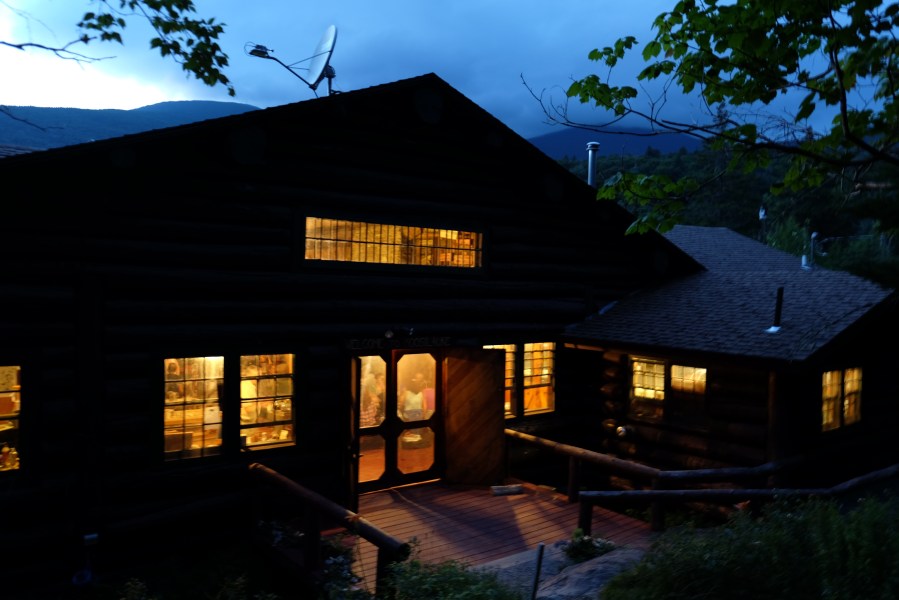
We stayed at the Moosilauke Ravine Lodge for the closing days of its summer season. Our daughter will be at the Lodge again in a few days, the last section of the last class of students to stay at the old Lodge for “trips.” We were decreed old-timers, and accordingly, we sought out our favorite seats from which to gaze at the familiar features that will pass with the old Lodge: the spruce logs, the wooden latch of the door to the porch. I realized that I was also seeing the wooden latches of my grandfather’s barns and shops. My nostalgia was not only for the Lodge but for the farm, the same farm that I described inside the back cover of David Hooke’s history of the DOC. It is for sale. How many other alumni are reflecting not only upon the passing of the Lodge, but also a former island summer home, or a camp on a pond? In so doing, we reflect upon the elastic bonds with farm-cousins, siblings and friends, even our own children who are graduating or matriculating, flying from the nest.
The Moosilauke experience has been created and re-created by Dartmouth, each generation making its choices and shaping its institution in the North Country: climbing to the Tip-Top House by carriage, skiing Hell’s Highway and sheltering at the winter ski lodge, or sprinting around Al Merrill Loop. Our farm is the home of a smaller clan, subject to the passing economies of western Maine. The descendants of MacKenzies and McLennans arrived from eastern Canada and set to farming, cutting and selling ice, and horse-logging for pulpwood. The Rumford mill still breathes on, given voice by Monica Wood. As the mill lives, the town lives, and the town has a flickering interest, now and then sending a bus of schoolchildren to learn about their forefathers’ experiences “once upon a farm.” The farm is not so much passive as tenacious in its retreat. Its wide southern exposure kept it in dairy long after other farmers left for the Midwest and their fields returned to woods. The town fathers continue to plow the road all the way to my aunt’s door after every snowstorm, rather than face her wrath. The young insurance agent would have had the barn torn down, but my cousin (very knowledgeable about construction) convinced her that the posts and beams, though well over a hundred years old, would actually be very hard to knock down if he tried.
Now the family has gone through the stages of grief, finally accepting that no adult grandchild will live there. The clan has taken its memorabilia to homes scattered far and wide. “Surely,” we think, “some family will buy the place and send children skiing and tobogganing around the back forty.” After all, the ski clubs of Rumford and Andover were the cradle of cross-country skiing and ski-jumping back in the day, thanks to the Scandinavians who came to work in the Maine woods. Al Merrill was a late son of those hills.
However, a new sorrow is emerging, that no one might buy the farm after all. While the College sends its grapple hook to swiftly dismantle the Lodge and then to rebuild it, the farmhouse might simply sit vacant as the roof begins to sag and sag some more. Perhaps when the mill closes and Boston warms, there will be a rising tide of immigration into the valleys and hills, bringing teleworking and affluence and rejoicing in the cool streams and trails of the wooded hills. Thus far that wave has reached only as far as Bethel. The farmhouse might become one more cellar hole on the mountain before someone builds a modern house beside it with the same view of the Androscoggin.
I remember one day in my freshman year, hiking the Appalachian Trail in Vermont on the beds of former farm roads running through young woods. I always notice the history in the stone walls. “I wish a few of these fields had been kept open,” I said. My classmate, a child of Boston, said “I wish all of the original forest were still here and that people had not cleared it for fields in the first place.” We hold so many visions and contradictory ideas of what we want to keep from the past and what we choose to honor from Ross McKenney’s era. It strikes me that the students and young alumni at the Lodge today are sad to see it go, but their hearts are with the mountain that will still be here with its forests as they know them. They are placing their hope in the sustainability of the carefully designed new Lodge and its future as the place to which they will bring their own children.
(September 2016; photograph courtesy H. Friday)
*David Hooke, “Reaching That Peak: 75 years of the Dartmouth Outing Club”
*Monica Wood, “When We Were the Kennedys”
*Crossland, Morgan, Stearns & Parent, “Once Upon a Farm: Stories about the Farm on Thompson Hill in Mexico, Maine”


 The Singing Forester