How does one approach an island?
(I invite you to read even if you are not interested in islands – I am making a broader point.)
Nowadays, by air. Through layers of clouds above broad blue waters, coming into focus with overlapping swells, over forested slopes and a reef onto the tarmac. Back in the day, one approached by sea, navigating by stars, swells, sun, birds, and other signs. Polynesians and Micronesians voyaged by sailing canoe, carrying plants and animals and children to new and empty islands, or carrying warriors and saudeleurs to conquer populated islands. I arrive by airplane, through a string of airports. At the first airport, I am a citizen, a member of the majority, hardly noticing one family of quiet islanders seated around the corner wearing not-Hawaiian dresses. With each airport I become less a citizen, and the islanders grow in number until I arrive as a visitor in their home, unheralded.
This island is a world of its own, with its own language and endemic species. Like a friend, it might be embarrassed to be named as my muse. It is part of a federation of islands, but it is largely sovereign. It is not a museum panorama; the very culture changes with choices, not the protests of a minority in a large state, but the choices and tradeoffs of citizens of a complete society. Each island has different patterns of choosing and changing – contemplative and deliberate, individually opportunistic, democratic, in secret, or blowing with the wind.
How do I approach the island? By day, as a professional, offering gifts of technical and financial assistance, asking my colleagues what they will request or accept. To be honest, I approach with plans. As I step into the first airport, I have lists, analyses, agenda, assumptions, presumptions. I think I already know my destination. As I enter into the reality of being on someone else’s island, I rethink. Is my final approach paternalistic? I remind myself to listen. With my graying hair, sometimes I’m called “auntie” or even “mother.” I need to learn, but I also find that I have real power to encourage.
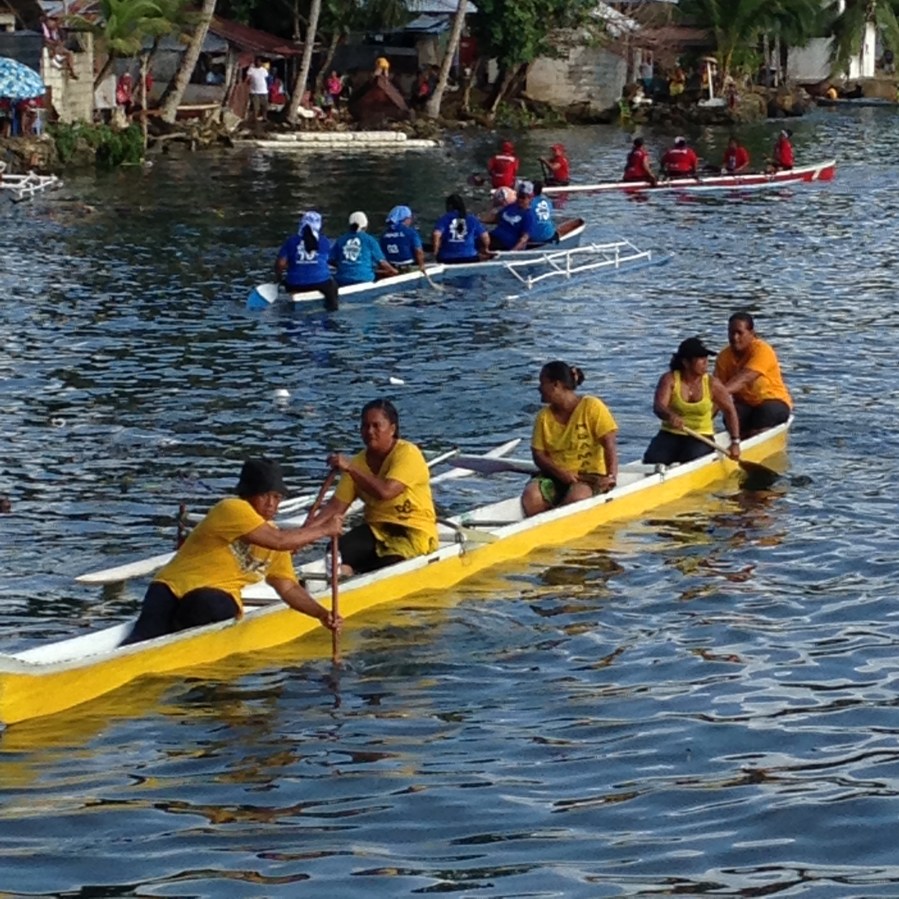
Outside of work, as a friend. I arrive on a Saturday and catch the last canoe races of the now-annual regatta. Each village has built its own canoes from trees from its own forest. (By the way, the conservation easement I worked on here allows the harvest of canoe logs.) At the regatta a few years ago, each village had a unique canoe design and whatever number of paddlers it thought would make the best crew. This time the races are separated into heats of crews with like number, with matching T-shirts. The canoes are still of the island’s own design, with less freeboard than Hawaiian canoes, outrigger on the right, and leaf-shaped paddles. The women are racing! The village wearing yellow begins a song that never stops. (That village is on a smaller island in the bay; it was the seat of the former kings, who commanded tribute from the villages of the larger island; I suspect that the yellow canoes are made from timber taken from the larger island, too.) The blue canoes straggle along next to last, but their young people are doing the most whooping and hollering (happily). I see the blue village paddlers driving home later – actually I hear them before I see them – a longer canoe than I ever thought could balance on a pickup truck, held in place by people all over the truck. On Sunday, I attend church on the smaller island; there’s not a word of English, but the entire congregation is a choir, now dressed in white.
By night, as a lonely soul, with jetlag. I’ve slept badly since the Tuesday before my travels. The little hotel room is an ugly box. At dawn, I can finally go out and walk the shoreline. To the trained eye, the cobbles and coastal trees show the signs of gradual realignment since a typhoon over a hundred years ago. Storms pass through Micronesia like a bowling ball through a set of pins, smashing one island and bypassing another. That was another reason for voyaging: all natural resources of a small islet might be lost to a storm or drought, and if the people could still assemble a canoe and some drinking coconuts for the journey, they would go to another island and call on clan ties, asking for hospitality. Entire atolls were thus devastated during El Niño years a century ago. At least one high (volcanic) island applied traditional values through its Westernized legal system, and designated tracts of land on the high island for the refugees and their descendants. This is a good story, a good model.
The tide is rising, this morning, this supermoon, this La Niña cycle, this century. The needle on the dial showing sea level predictions jumps around with every scenario, but is steadily rising each time the models of best available information are run. Cataclysms happen to the loveliest of islands. After the European and American sailing ships of exploration and commerce came visiting, nearly a generation of women bore few children. The population declined from several thousand to a few hundred people, who then embraced the church and its commandments for protection against the whalers and beachcombers and blackbirders. The missionaries were not perfect, but they were good. In the second World War, the U.S. military liberated the island; we were not perfect, but we were the good guys. Here. Then. Not on the island next door, next decade, when we detonated nuclear bombs in our protectorate, a combination of hubris and cavalier disregard and deliberate observation of the effects on humans of another culture not granted human rights. Our own government can do things like that. Keep that in mind.
The island is resilient. My colleague brings me fifteen pounds of tangerines from his farm (for my carry-on luggage). If I have to get stranded somewhere, this would be a good place, for warm rain and fertile soils, people who know how to grow food, and generosity to friends and strangers. The words “poor” and “poverty” cannot be easily translated in one island language; however little one owns, one has family and neighbors. There is a word for “destitute,” describing circumstances when the community has no food to share, or one has completely set oneself at odds with the community. I haven’t learned these languages as I did Ilokano, but a full translation of one word can reveal another world. Aloha is not a word to attract tourists; it has profound meaning in Hawaiian. Amongst the general public in Hilo, it’s a mutually understood exhortation, an agreed-upon virtue, even if not universally practiced. Like the churches agree on agape love. Like the Greatest Generation agreed on sacrifice and courage and doing the right thing. Generosity to friend and stranger is the virtue I can most learn from this island.
How does one approach the Bible?
(Bear with me, please, if you are not a Christian – I am making a broader point.)
From cover to cover? Good luck with that. Some Bibles are printed with all the words of Jesus in red ink. There’s an edition that uses green ink for all the passages that speak of our natural world and support environmental stewardship. That’s affirming for my work, and thought-provoking for others, but – after a point, that verges on looking for proof texts to support preconceived positions. My college chaplain taught us to read a given passage first to understand the literal meaning of the vocabulary and narrative; second to understand its intended message for the people in its original context and culture; and third to discern the applicability of that message to our own lives. But which passage? As a classmate said, “It’s a big book.” Of course it is in the most confused and disturbing situations that we ask – where’s the love? Why are the churches divided? Why is my brother or sister at odds with me? Where is the Spirit leading us? Some approaches lead from bad to good – injustice to righteousness, pride to humility, sin to repentance, alienation to love, from chaos and futility to awareness and commitment. Some approaches lead us from one value to another, a complementary and necessary additional dimension. From law to mercy. From individual strength to fellowship. From conformity and obedience to prophetic proclamation. From faith to works. Some stories and journeys provide metaphors of hope – from Egypt to the promised land. Courage in the face of the apocalypse. For each person, for every thing, there is a season, a time to speak out, and a time to be quiet. A passage rests with me at midnight – “True religion is this: to care for orphans and widows in their distress, and to do every thing as if in the presence of God.”
How does one approach a friend?
A sister, a brother, a friend of my childhood. The central paradigm of my childhood was a canoe going downriver, rapidly. Two paddlers and a rock. Left or right. Communicate and agree. (Majority vote does not work in this situation.) To avoid right-left confusion, my father painted the canoe’s gunwales red on the left, green on the right, trying for visual if not verbal communication. (The slalom poles were laid out in red-and-green pairs. The rocks were patterned according to whatever canoes of color had scraped over them. The center route, between the poles or rocks, usually worked best. But I digress.) It doesn’t help that there are two unrelated meanings of “right.” “Go left!” came the call; “Right!” came the affirmation – or was it the start of an argument? We do agree that we don’t want to hit the rocks.
My friends from college, my friends from Peace Corps, my friends who can pick up a conversation after decades, who have scattered far and wide. So different from small islands, where people know they’ll be living next door to each other for the rest of their lives. They know they have to get along, but sometimes the tactic is mutual avoidance. In our large country, mutual avoidance means separating into different communities, our dialects diverging. Why does he treat “diversity” as a bad word? What does “liberal” mean? What did it mean before? What is the root word of “evangelical?” How did that become a political demographic? Of course, we can understand each other. The challenge is to choose: dialogue over debate and investigation over cheap shots.
My neighbors, the parents of my children’s friends, the uncles of my children’s teammates – three degrees of separation from common experience. I remember one end-of-season potluck for a soccer team of six-year-olds who lost every single game. The distribution of participation trophies was perfunctory and the coach went home. The remaining families looked at each other. I could see some were wondering what on earth they had to say to this mainland haole family. Two good topics to build bridges are children and food. The children topic wasn’t winning in this case. “Is that chicken adobo?” “You know what is, ‘adobo’?” Disbelieving smiles. More adobo. Pancit. Discussion of balut. More smiles and laughter. Thank goodness there was no “jumping salad.” Even communing over food often requires someone to get out of their comfort zone!
My children, the friends of my children, the fruit of our communities, encountering the worlds outside their islands. I open my eyes and they have become articulate young adults, increasingly the “doers.” They are beginning to make the choices that will shape our society. Encourage.
With thanksgiving.
(Written during the days and weeks after the November 2016 election)


 The Singing Forester