(July 2018) We lost a place this week. Ahalanui, I say with respect and humility, because only now I am learning that Ahalanui is “the great transgression,” a land division. I am not the one to write the obituary for the warm ponds, their history, the coastal trees, the shoreline facing the Pacific winds. I am not the one to tell or to keep secret the stories of the ceremonies of the ponds, of what was that great transgression, where the people of the village lived and were buried, or how they fared when a kingdom and a republic and a territorial government washed over them. There were names, I am sure, for each pond, and the old village, and more. The school there, Kua O Ka Lā, developed a place-based curriculum, and now lava has transgressed all – the school, its garden, the ponds, the shoreline, the village, buried as deep as the bones in any grave.
At first, there were no casualties from the new eruption, and we were grateful to know that even though houses were lost, people were sharing other places to live. But then a sudden day came when a deep hidden lake within Pu’u Kapoho was evaporated and filled. Evaporated? It seemed like some far-fetched disaster movie: how does a lake boil away and cease to be within hours? The river of lava took a deliberate turn around the pu’u, following the path of steepest descent, and a rivulet of lava took the yet slightly steeper descent into the old crater’s heart. Just enough lava to send up a plume of white steam that rose narrow and high and then ceased. Empty now, the old deep vent became the brim of a narrow waterfall of lava, two hundred feet to fill. And then Kapoho Bay itself was in the path of such a wide and relentless front of lava that the whole island community gasped, as if the bay were the first person facing death in the eruption. The bay became a peninsula, the lava front widened and shifted and one place after another was obliterated. Now we pray for Pohoiki and other places that I don’t know but others do.
Can a place be a person? The river of the Whanganui in New Zealand (Aotearoa) has been given legal recognition as a living entity, reflecting the worldview of the Maori people. Not inconsequently, personhood does (or should) demand legal consideration of needs for health and existence, when threatened by others. Whanganui, and then Taranaki, and other places are beginning to enjoy this precedent. It is not only lava but bulldozers and pollutants and the fire-invasive-grass complex that can crush living things and transform the very shape of the earth. Even Kapoho was already suffering, as the ways that people loved it were stressing and changing it. Like so many coastal communities, the clear waters and plentiful fish drew people until those qualities were undermined. But, as for a person, beauty can be found behind the battered faces and troubled histories of the places that have suffered. The water was still enticing and the fish still enchanting. The natural coastline was shaped into fishponds by the ancient Hawaiians, and that human alteration became a treasured natural and archaeological resource. The bay and its fishponds were overlaid with suburban development, and then the maze of homes and lanes and walls and channels became places of family memories.
Old placenames capture our memories. An old topographic map recorded a placename at a high elevation that, translated, was a clue that there had once been a wetland where nēnē that would stop – reminding us that there was once more forest and rain there, and revealing migratory paths of the goose that nearly went extinct. This was an inspiring discovery as scientists worked to not only restore nēnē populations but also to understand and restore their natural movement patterns and routes.
Maybe a place can better be considered a church. A church is an ecosystem of people and God and maybe a building filled with art and memories. As lava overran Kalapana, the “Star of the Sea” church building and the art painted directly on its walls was hastily moved by truck to neighboring Kaimu! But even if that “Painted Church” had been consumed by the lava, the true Church would have continued, comprising the people and God. If a place is a church, then it is a symbiosis of the living things on the soil and the old lava rock, the trade winds and blessing rains, and the people who have been imprinted by their appreciation of the land as created by God and as lived in by them. A place of art and worship, named by its people. I looked up the difference between a “word” and a “name” – a name is an honorific; we honor the place that is more than the sum of the parts. The place gone or changed, the people and nēnē continue.
We seek restoration and creativity. The new lava coastline has complex and surprising small bays and pools, and an unexpected island that developed its own little tombolo of black sand within days. All ephemeral, but we know the new land and its features will belong to the state, not subject to the old gates. Kua O Ka Lā will regather its teachers and children at new addresses, places that may feel empty at first but that will be filled. People are asking for the kūpuna to give “Fissure 8” a proper placename. There are cinder cones all over the island, some hidden behind developments, some grazed to the bone, some mined for fill, some bulldozed away altogether. We do remember the names of many, and recognize them as kīpuka (islands of older soil and forest, often with many rare species, surrounded by younger flows). We want the new pu’u to be sanctified by the naming, and to become known as the new force not just of destruction but also creation.
(December 2018) Postscript for Pohoiki
The lava that flowed over eastern Puna last June and July seemed to doom that raw coast’s only remaining point of access to the ocean. I wrote a eulogy for places and placenames that echoed a hashtag, “pray for Pohoiki.” I did think it would be inundated by morning. But Pele has a way of stopping at the edge of sacred places, at least for a time. The rhythm of summit earthquakes began to synchronize with ebbs and spurts of the previously gushing flow. The river of lava, no longer fed so vigorously at the source, slowed and solidified in early August. The lava’s most distant toe hesitated before dipping into the bay, instead freezing into a ten-foot high wall at the edge of the park. Yet the work of creation was not done. Lava to the east had been shattered into tiny fragments in steam explosions as it fell into the ocean offshore from what used to be Kapoho Bay. Lighter than granules abraded from solid basalt by waves, black sand puffs swept downstream in the longshore currents. What had been the crescent bay of Pohoiki became a broad black beach enveloping the mouth of the bay and the boat ramp. The inner sanctuary of the bay became a warm pond tucked behind the sand, days before the lava glow disappeared from the fissure in Leilani.
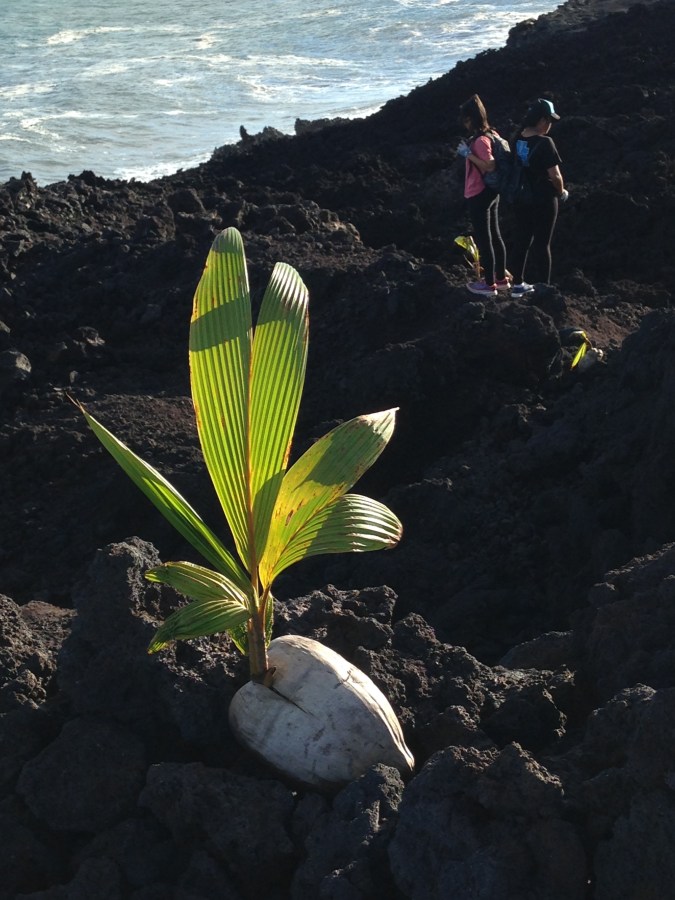
Eager to see the new world, people quickly created trails across the two jagged ‘a’a flows that in June had cut off the road and bisected the landscape from Leilani to the ocean west of Pohoiki. Menehune moved small cinders into a winding path of low rubble-filled spots where feet could tread safely between vicious spikes of upended glass-sharp rocks. Surfers intent on reaching their waves began to regularly make the hour-long trek, carrying surfboards along the new shoreline route over the end of the two flows. The trails were marked by coconuts, bright green cairns in the unexpected byways. Called the “tree of life” throughout the Pacific, sprouted coconuts are self-contained planters, with quick large vigorous leaflets emerging from and fed by a pot of sweet congealed nut milk and meat. The coir and husk protect the young plant and sustain the roots reaching into the cooled lava below.
The county reopened the park at Pohoiki. The children and teachers of Kua O Ka Lā, the school lost to the lava at Ahalanui, joined the blessing ceremony. The Hawaii Board of Geographic names is considering what to call the now-quiet cinder cone in Leilani where the original lava vents had coalesced. A woman had a dream in which her ancestors gave the name “Keahiluawalu O Pele.” The meaning of the name is still unknown to me, either a secret or a quest.


 The Singing Forester