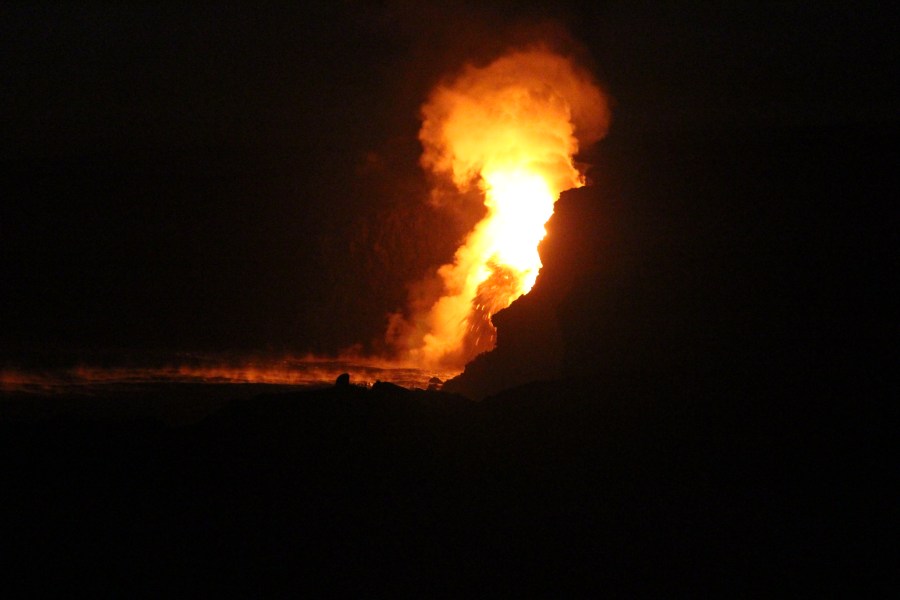
We went to see the lava flowing into the sea. I had not ventured to see the lava since Mayon’s mother, Nancy, died in November. The flow had veered away from the Park toward Puna, so it was time. We drove to the end of the highway and over the now-cold lava that had flowed through Kalapana some years ago. Our demigod of a mayor, Harry Kim, had faced Pele and evacuated residents to safety at that time. Now, he had laid out a road and trail for us to follow, as safe as safe could be. Large signs explained the geology of the area and gave safety tips and warnings; we searched the cautionary tales for Nancy’s story – steam inhalation, I had heard.
Nathanael shined his flashlight at the moon, at the forested kipuka, at the far-off flows over the pali, at the steam rising from the ocean entry, and at our faces, until we took the light away from him. The moon was bright enough to keep us on the cinder road, but we could still see stars beyond stars between the shifting clouds. We needed the lights again when we began to hike on the trail over pahoehoe. Nathanael chattered away until he suddenly said, “I feel a little scared.” A hiker passing in the dark chuckled at him. The lights from the lava tubes on the pali were closer now, and their shapes had changed. As we neared the ocean entry, we saw the steam cloud glowing orange and occasional explosions of lava. “Wow!” said Nathanael. “Like fireworks!”
We heard and felt surf thudding, and then the mayor’s signs, lights and guardrails brought us to a safe viewing-point at the top of a small sea-cliff. Water ebbed and flowed on the black sand before us, and engulfed the delta of glowing lava at the other end of the crescent beach. Waves surged and quenched the lava, then drew back, allowing the lava to run over the rocks and cliffs. The steam cooled to gray, then rose again in orange. “Which is winning?” I asked Nathanael.
“The lava, because it is turning the ocean into steam,” he said.
“But there is always more ocean,” said J.B.
Currents along the shore brought simmering hot and acidic water to the beach. The sand was freshly born, shattered from rock cooling as it hit the water; it sat on a lava shelf over geologically infant rubble, liable to collapse in a moment or a year. Only a fool or a suicide would venture to swim in the beautiful waves, even a half mile this side of the lava entry. I saw that the trade winds blew the plume out to sea. A sudden shift of wind might take the steam into the Park, but not back at us.
The surf and the orange lava and the steam swirled back and forth, again and again, without end, like Esau and Jacob struggling eternally. My neighbors and countrymen had watched, again and again, as the planes flew forward, the orange flames mushroomed, and the towers collapsed in smoke. With no television, I had seen only the few still photos, glimpses of what hung so heavily from my heart. I felt obliged, compelled, to see and know what had happened; I listened to the radio while caring for my children, and read the newspapers after they went to bed. My neighbors finally tore their eyes away and turned the screen black, and I finally went to see the lava.
We watched and watched. That night, it was an inferno without sin and without suffering; no crazed soul flew into it, sending five thousand more flying without warning to the heavens. The molten rock, air, fire, and water were clean and beautiful. Now and then a fresh burst of fireworks rewarded us. Nathanael was no longer afraid. Finally, we turned for home, halfway healed, having for the first time some idea of purgatory.
(Photograph courtesy J.B. Friday)


 The Singing Forester